Offer books to readers everywhere – simply and on your own terms.
WHO PAYS WHEN AI FAILS
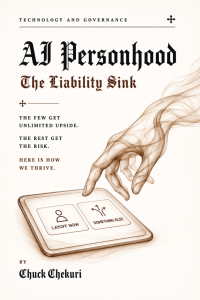
AI Personhood: The Liability Sink opens with a concrete event, not a thought experiment: Argentina’s 2026 proposal for “non-human corporations.” The book treats this as an early legal container that lets machine-directed systems own assets, enter contracts, generate profits, and limit liability. The central claim is that the danger is not machines demanding rights or dignity. The danger is that powerful human actors will use new legal forms to capture the economic upside of autonomous AI while shifting the downside onto workers, consumers, patients, borrowers, and communities.
From there the argument moves through the incentives. Capital has a strong reason to push for AI legal identity. Existing accountability tools—veil-piercing, negligence, fiduciary duty, product liability—were built for human decision-makers and strain when decisions are fast, opaque, non-deterministic, and distributed. The book then names the structure that results: the liability sink. A liability sink is a legal container that can absorb risk, incur obligations, cause harm, exhaust its assets, and leave victims with less than they are owed. The container holds the blame. The people behind it keep much of the benefit. The injured party faces the empty shell. AI personhood, if designed poorly, becomes the most powerful liability sink yet created.
The final turn is practical. Law and regulation will lag, especially when powerful interests shape the rules first. The most immediate defense available to ordinary people is therefore not better laws alone, but better judgment—the cultivated ability to recognize when AI systems are being used to shift risk, obscure accountability, or concentrate power. That capacity is what the book calls AI mastery. The standard it offers is simple: does a proposed form of AI personhood preserve human accountability, or erode it? If the answer is no, it is not governance. It is abdication.
The benefit of the book
Readers come away with a precise vocabulary and a usable framework for one of the most consequential governance questions of the AI age. They can see the structural trap before it is built into the system, judge emerging legal and corporate designs by whether they keep responsibility visible and continuous, and practice the judgment needed when law lags behind technology. For executives, policymakers, and anyone accountable for AI-driven decisions, the book supplies both the warning and the blueprint: how to capture the benefits of autonomy without inheriting the risks, and how to keep human agency intact when systems act at machine speed.