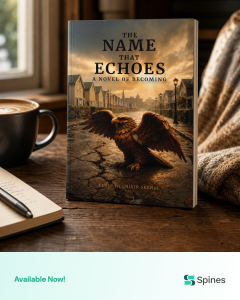
Offer books to readers everywhere – simply and on your own terms.
Offer books to readers everywhere – simply and on your own terms.
The wooden eagle rested in Alexander’s lap. He picked it up and turned it over in his hands the way he did when he wasn’t thinking about anything. His grandfather had pressed it into his hands at the airport without a word, stepped back, and took a long look at him. Then walked back into the terminal and didn’t turn around. Alexander was seven. He had watched his grandfather walk away until he couldn’t see him anymore. That was eight hours ago now, or close to it.
“Alexander,” his mother said from the front seat. Just his name.
He knew the question.
“Alexander is for greatness,” he said. “Terver means God has ordained. Zever—” he turned the eagle over. “Zever means to say the same thing. Over and over.”
“Why over and over?” His father asked without taking his eyes from the road.
Alexander thought about it. “Because some things need to be said more than once before they’re heard?”
His father breathed out through his nose. His mother’s hand came back and touched his knee, then withdrew.
The road had narrowed. Trees tight on both sides, branches almost touching overhead.
“Tell me about the eagle.”
“You know the eagle.”
“Tell me again.”
The rain had resumed falling. His father was quiet for a bit.
“When the storm comes, other birds take shelter. The eagle’s the only one that opens its wings and takes advantage of the storm and the wind to rise even higher.” He paused. “Above the clouds, it’s still sunny.”
Outside the window, one star peeped through a gap between the clouds. Alexander put his finger against the glass where it was.
“Mama. You think the tortoise was wrong? Keeping all the wisdom?”
She turned partway. “What do you think?”
“Wisdom gets smaller when you keep it.”
“Where did you hear that?”
“I didn’t. I just thought it.”
His father glanced at him through the mirror, and said nothing after. But Alexander had seen the look that went between them first, the fast one. They didn’t know he caught those.
Then the deer just seemed to appear.
His father’s foot pumped the brakes hard, his hands turning the steering wheel. A sound came from under the car like something pulling loose from where it was attached. And then there was no road under them. And then Alexander wasn’t thinking anything at all, only his chest against the seat belt. The eagle had fallen somewhere; everything was going in the wrong direction, and then there was the hard stop that took the sound with it.
The interior light flickered once. The one headlight left was pointing into the bank wrong. All he could see was mud and roots.
“Mom.”
He pushed and pulled at the seatbelt buckle. His fingers weren’t doing what he told them. But he got it eventually.
“Dad.”
His father was facing away. His mother’s hand rested awkwardly on the console, palm up, the fingers a little bent. That was how her hand looked when she fell asleep with a book open. He took it in both of his.
It was still warm.
He didn’t know how much time had passed. The rain had stopped by the time the lights came. The headlights had gone out. He was holding her hand when the colors showed through the windshield. Red and then blue and then both, coming closer.
He heard them before the door opened.
“Over here.”
“There’s a child—”
Alexander felt a blast of cold air when the door opened. A man in a yellow jacket leaned in, moving a flashlight.
“Hey. Hear me, buddy?”
Alexander nodded.
“Good. Stay where you are. We’re coming.”
The man saw where Alexander was looking: her hand, still in his. The man didn’t say anything for a moment.
“Okay,” he said. “Okay.”
The eagle was in the grass a few feet from the car. Someone put it in Alexander’s hands when they lifted him. He held it against his chest and looked up. Through a gap in the trees, he looked at the sky. It was dark the whole way through.
The weeks that followed had no shape. People came. Relatives he recognized by name but not really by face. A government woman came twice, each time with a different folder. There were forms to sign that he didn’t sign himself. He only saw his name in boxes.
In the second week, a couple came by. They were different from the other visitors. They seemed comfortable and didn’t sit at the edges of chairs. They had brought a book about North American birds and asked if he wanted to look through it. The man found the bald eagle page and said, “Did you know they can see four times farther than us?” Then he just waited, not saying anything else. He watched Alexander the way you watch something you’re genuinely curious about.
The couple introduced themselves as Jonathan and Eleanor Whitman. They talked about a town, a room waiting, and a school.
The day he left, the social worker handed him a box. His clothes were in the box, as was a photograph. The photograph was face-down, and he left it that way. The carved eagle was in the box as well, with its mended wing, repaired so well he had to look closely to find where it had cracked.
Eleanor talked on the drive. She spoke mostly of school, and also about the neighbors and an oak tree. Jonathan drove and mostly didn’t speak. Alexander sat in the back, holding the eagle, running his thumb back and forth along where the wing had been fixed.
“We thought,” Eleanor said carefully, “it might be easier at school, for now, to use Alex Whitman. Just while you settle. You can always—”
“My name is Alexander Terver Zever.”
Silence.
“Of course,” Eleanor said. “Of course it is.”
He put the eagle on the seat next to him. Outside, the road kept coming. The sign at the edge of the town said “Welcome to Comfortville” in green. Below that, smaller text: A Place Where Everyone Belongs.
He watched it pass.
He didn’t sleep.