Offer books to readers everywhere – simply and on your own terms.
Offer books to readers everywhere – simply and on your own terms.
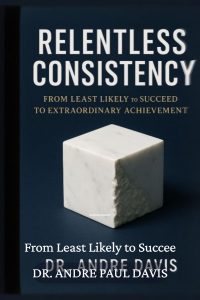
by Dr. Andre Davis
How the “Least Likely to Succeed” Defied Labels, Blocked Out the Noise, and Mastered the Process of Extraordinary Achievement.
The voicemail was brief, the kind you replay because it does not say enough— “Please call the surgeon’s office as soon as
possible.” I was recovering from a “routine” removal of a lump on the back of my right leg; the kind I had been told was
likely a fatty mass. No pain, no drama —just an inconvenience stitched up and draining, with me sleeping on
my stomach to keep infection away. When I returned the call, the room around me tightened to a pinpoint. The pathology
had come back. The growth was cancerous. We needed to discuss next steps.
In a life already straining—ten years into a marriage that was cracking under the grind of entrepreneurship, the money, the
partners, the pressure—that single word changed the air I breathed. I did not think “Big C.” I thought: my children. I thought:
what now? Within days, I was scheduling a second surgery at a top research hospital in North Carolina, mapping out more
than twenty radiation treatments, and staring at a recovery plan that would leave me with 73% usage of my right leg.
Control, the currency I had traded in for years, evaporated.
All I had left was the next step. Treatment reorganized my days into small, stubborn acts. Radiation. Drain tubes.
Dressings. Pain did not ask permission. Lawyer calls for divorce proceedings. The quiet worry about whether my sons and
daughter would come through the storm whole. I was not the only one in it, and stress—every clinician reminded me—is a
terrible companion for healing. So, I wrote. I journaled the appointments, the faces, the dull gray of waiting rooms. And
one day, in the back area where patients change after treatment, I met a 20-year-old college baseball player, prime of life,
who told me he had rectal cancer. The air left my chest when he said it. I remembered my own twenty-year-old body, the
speed, the invincibility; I pictured what this diagnosis would have done to me then. Yet he was steady, even smiling. Grit.
Determination. Fortitude. His story snapped my perspective into place. I had burdens; yes. I did not have permission to
quit.
Life did not pause for treatment. On Sundays I climbed into the pulpit with a walker and sat in a chair to preach to a
congregation that prayed me through. “Why not stay home and rest?” people asked. Because movement is life. Movement
keeps you alive. One of mentors once said, “It is hard to shoot a moving target.” So, I moved—tiny, wobbly, stubborn steps.
Between sermons and scans, I pushed through doctoral research, because purpose, even when reduced to inches,
keeps your spirit from collapsing. Recovery was not linear. It rarely is. But the rhythm—show up, do the next thing, go home
—stacked days into a lifeline.
I wish I could tell you cancer visited once and honored the door closing behind it. In 2012, it came back—same place, same
fight, same treatments, same long, slow climb. By then I knew the terrain: faith, family, a good team of doctors, and a plan
I could do on my worst days. Not a dramatic plan. A consistent one.
Cancer taught me the truth I did not want to learn; control is fragile; consistency is freedom. We do not get to choose
every storm, but we do choose our stance inside it—the habits we keep when we are scared, tired, or grieving. When
control vanished, consistency gave me rails to hold: a 10-minute task when a 60-minute one was impossible; a walk
to the mailbox when a workout was fantasy; a single page of writing when a chapter would not come; a prayer
whispered when bold faith felt far away. Tiny, faithful actions stabilized what fear tried to splinter. They created
momentum where motivation could not be trusted, dignity where circumstances tried to take it, and progress
measured not in miles but in inches—enough inches, repeated, to become miles again. Consistency did not cure my
cancer. It rebuilt my life around what I could do today. This book begins where my plans ended and a different kind
of power began: the power of showing up—especially when you do not feel ready, strong, or in control. In Chapter 1,
we will start with the first commitment of “Relentless Consistency: Forget Perfect; Choose Consistent.” I will show
you the exact, simple practices I used in hospital halls, courtrooms, and quiet mornings with a walker at my side, the
same practices you can use to turn any season, however hard, into forward motion. Let’s take the next step—
together.