Offer books to readers everywhere – simply and on your own terms.
Offer books to readers everywhere – simply and on your own terms.
I have often reflected on the Christmas when my grandparents chose not to put up a tree.
It wasn’t because they couldn’t afford one or because they had forgotten the joy Christmas once brought to their home. It was because three of their sons were away serving during World War II: Frank, Anthony, and Joseph.
While neighbors hung lights and children eagerly counted down the days until Christmas morning, my grandparents lived from letter to letter, hoping each envelope would bring good news and fearing every unexpected knock at the door.
The corner where the Christmas tree usually stood remained empty. To many, this may have seemed like a simple decision; to my grandparents, it was something much deeper. It was a quiet expression of love, worry, and the unbearable uncertainty that comes with waiting for the people you love to come home.
Long before I understood the sacrifices made by those who serve in the military, I began to grasp something else: war doesn’t only leave its mark on the battlefield. It leaves its mark at the kitchen table, in empty bedrooms, in unanswered prayers, and sometimes, in a home without a Christmas tree.
As the war continued, something happened that our family would talk about for generations. Somewhere in Europe, my Uncle Frank walked into a tent at a military base and noticed a young soldier standing in line.
“That looks like my little brother,” he thought. It was. Against all odds, he had unexpectedly found his younger brother, Tony.
For a brief moment, the war provided them with something it often took away from families—a chance to be together. As an officer, Uncle Frank had access to better food, showers, and supplies. Before they parted ways again, he made sure to take care of his little brother. He found him a good meal, arranged for a hot shower, provided a new pair of boots, and offered fresh clothing.
Years later, this story became a cherished part of our family history—not because of medals or military victories, but because it reminded us that even in the midst of war, there were moments of love, laughter, and brotherhood. Whenever the brothers gathered, they loved telling that story. Uncle Frank and Uncle Tony would tease my Uncle Joe, who had served in the United States Navy. With big smiles, they would say, “What do you know about fighting? You spent the whole war on a ship!”
It was the kind of good-natured ribbing that only brothers could share. Looking back now, I realize those stories weren’t really about who had the better assignment or who had it harder. They were about three brothers who all answered their country’s call in different ways, returned home safely, and spent the rest of their lives grateful to still have one another.
I often imagine what my grandparents would have felt had they known: three sons, together, alive—even if only for a moment.
The war eventually ended, and my grandparents welcomed their sons home. Like so many military families, life moved forward, but the experiences they lived through became part of our family’s story forever.
Years later, another generation answered the call.
My father, Staff Sergeant William Handley, proudly served in the United States Army during the Korean War era while stationed in Germany. He rarely spoke about his military service, but I came to understand that silence does not mean the absence of memories. Sometimes, it is simply another way of carrying grief.
My Uncle George Handley also chose a life of service. His childhood dream was to become a physician, and through the Army, he was able to pursue that calling. He became a pulmonologist, retired as a Colonel, and devoted his life to caring for others. During his military career, he was invited to participate in the space program, but chose to remain focused on medicine. Becoming a doctor had been his lifelong dream, and he never lost sight of it.
Looking back now, I realize military service has always been woven into the fabric of my family’s story. So, too, has grief.
It belongs not only to those who wore the uniform, but also to the parents who waited, the spouses who counted the days, the children who grew up too quickly, and the families who learned that service often asks something of everyone who loves a veteran.
As I began listening to veterans share their stories, I realized something profound: many of them had spent years believing they were carrying their grief alone. They weren’t. Their stories echoed the same quiet burdens my family had carried for generations.
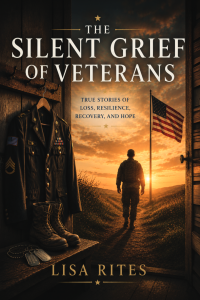
This book exists because those stories deserve to be heard. Service leaves more than memories; it leaves invisible wounds, enduring strength, families forever changed, and a legacy that deserves to be remembered.
As you turn the pages, you will meet veterans from different branches, wars, backgrounds, and walks of life. Their experiences are unique, but they are all connected by something they deeply understand—the silent grief that too often goes unseen.
These are their stories.